
Photo Essay: Ritual Animal Slaughter — are they sacred or are they scared?
Photography and writing by Shivani Nelson.
Shivani Nelson is a journalism student at The New School and participated in the Sanctuary Doc mentorship program to complete this story on her experience documenting Halal and Kosher slaughter, and the meaning of sanctuary.
Content warning: We know that some of these images are hard to stay with, and in the same way, it was hard for Shivani to be in these spaces. Our hope is that we can hold the suffering of all involved together: yours as witness, Shivani’s as photographer, and the animals as “sacrifice.”
“No camera! No camera!” Two slaughterhouse workers shouted at me as they hustled me out of a Halal slaughterhouse in Brooklyn, New York.
Halal slaughter is a method of slaughter that follows Islamic law. The laws require a prayer to be recited during the killing, and the prayer must be recited by a sane adult Muslim.
The actual rules to be followed during the slaughter are to use a sharp knife and slit the throat of the animal deeply and once, cutting through the windpipe, esophagus, and two carotid arteries.
Other religions such as Judaism follow similar rules. Kosher slaughter must be performed by a Shochet, a certified Jewish ritual slaughterer. Kosher slaughter also requires a sharp knife to slit the throat of the animal in one deep cut, cutting the trachea, esophagus, and the carotid arteries.
Halal and kosher are taught as holy and merciful practices and the slaughter is framed as a sacrifice for religious purposes.
As I jogged up the block away from the men ushering me out of the slaughterhouse, my curiosity morphed into one question: why was documenting these holy and sacred methods of killing being met with hostility?
In high school, I started doing animal rescue work. I worked at various sanctuaries around the country that housed animals rescued predominantly from agriculture. When I got older, I began going to slaughterhouses to understand more about the facilities animals were being rescued from. I would tell friends and family about what I saw at these slaughterhouses, but I always felt like they didn’t quite understand how devastating it was.
I was met with some version of, “but the meat I buy is organic, local, humane, halal, kosher, etc...”
They were buzzwords to me.
I had been to the small family-owned farms that were “humanely” taking lives. I wanted everyone to come with me so I could show them what I witnessed. My thought was if they saw what I saw, they would never buy an animal product again. The problem became that it was hard enough just for me to get in, let alone try to bring a large group to watch the slaughter.
The slaughterhouses often kicked me out when they saw me recording, even if I told them I was doing a pro-Halal project. I eventually decided I needed to get footage.
Living in D.C. at the time, the majority of the farms using the slaughterhouse buzzwords were “Halal.” I visited the slaughterhouses surrounding D.C. as much as I could, but the blurry iPhone footage only swayed so many people.
When I moved to New York a few years later, I decided to go with an actual camera, and began this project.
After documenting inside Halal slaughterhouses in New York, I took my investigation to Türkiye.
In Istanbul, Islamic law has shaped everyday life including the food practices. Each time I witnessed an animal being slaughtered, I heard the prayer recited. This prayer in Arabic, “Bismillah-Allahu Akbar” translates to “In the name of God, the greatest.” The prayer invokes God’s name while also sanctifying the killing, framing slaughter as obedience to God rather than violence.
It seemed that all of the animals I watched die knew what was coming. They appeared to fight for their lives until the very last second. The prayer changed nothing about the fear in their eyes when they laid on the slaughterhouse floor, watching each other die, knowing they were next.
Even as their throats were slit and they bled out, they kicked and fought until they lost consciousness. I couldn’t help but think about how we could deem this a holy act, and convince people through a quick prayer, that these animals were somehow willingly being sacrificed.
After returning from Türkiye, I attended Kaporos (also known as Kapparot) in Brooklyn, New York. Kaporos is a yearly ritual practiced by certain Orthodox and Hasidic communities before the Day of Atonement, commonly known as Yom Kippur.
Chickens are swung over an individual’s head three times while a prayer is recited. The ritual symbolizes the ridding of one’s sins by transferring them to a chicken.
The prayer recited before slaughter in Hebrew is, “Baruch atah Adonai Eloheinu Melech ha’olam asher kid’shanu b’mitzvotav v’tzivanu al ha’shechita,” which translates to, “Blessed are You, Lord our God, King of the Universe, Who has sanctified us with His commandments and commanded us concerning slaughter.”
I began to realize, throughout these religious slaughters, sanctification was often claimed as something that happened through prayers or rituals, without changing the physical reality of the situation for the animal.
I was left with a feeling that there was nothing holy about what I had witnessed in Halal slaughterhouses and at Kaporos. Fundamentally, these are no different from the factory farms that are notorious for their abusive treatment of animals.
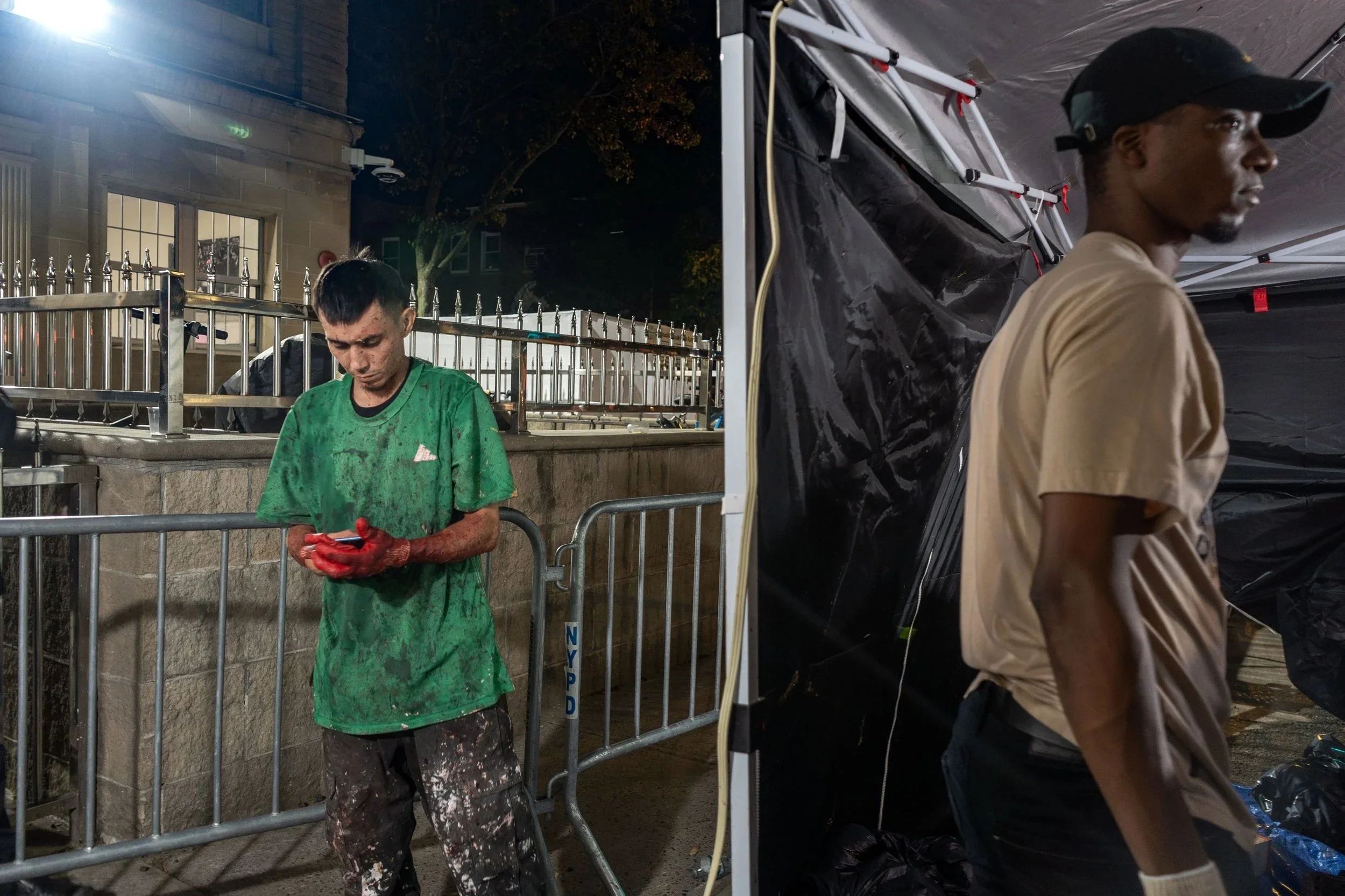
Two men hired to kill chickens for Kaporos stand in a gated slaughter area in Brooklyn, New York, September, 2025. Shivani Nelson / Sanctuary Doc
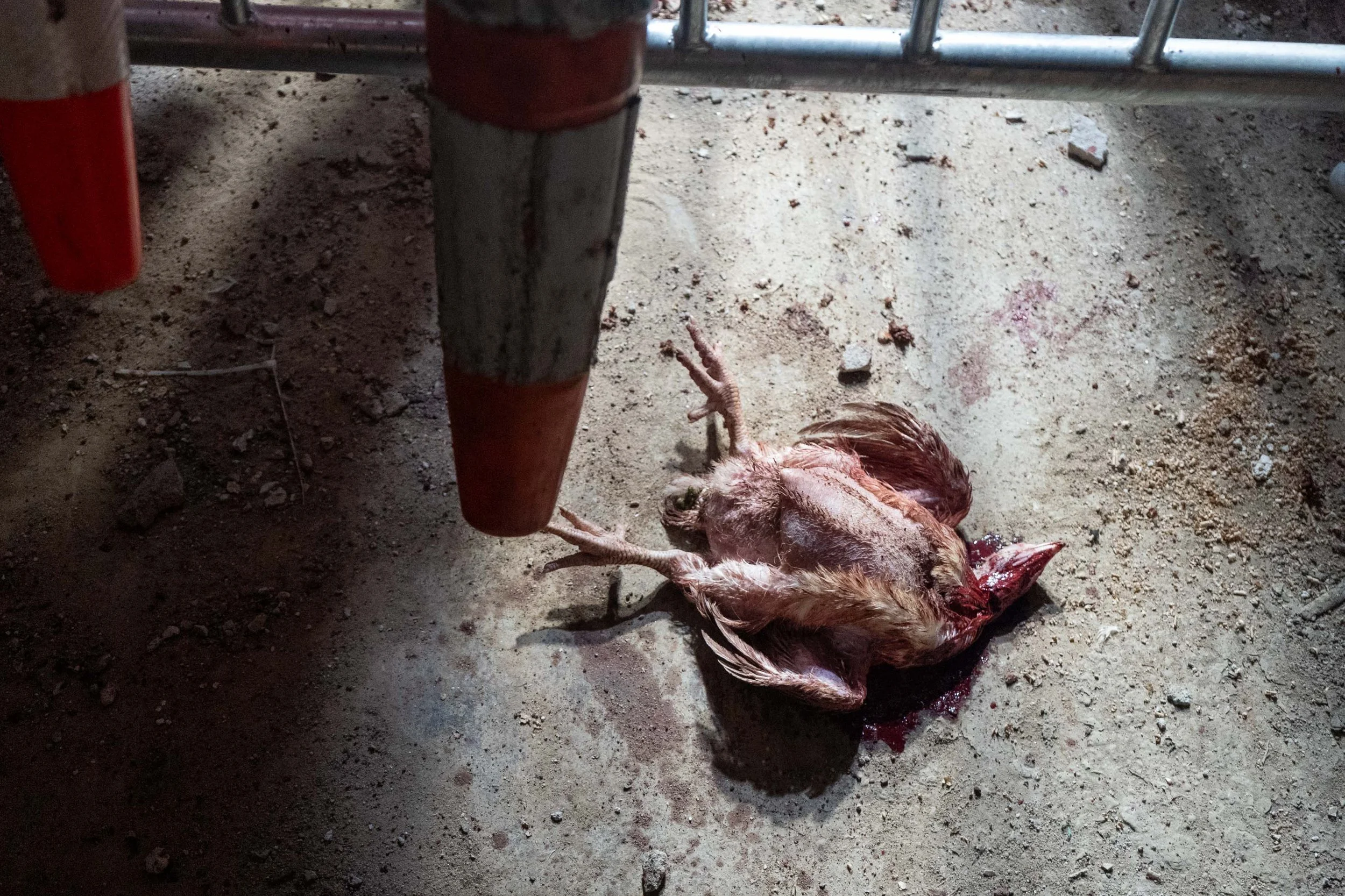
A chicken lies lifeless on the ground at Kaporos in Brooklyn, New York, September, 2025. Shivani Nelson / Sanctuary Doc
I began to wonder what the physical reality of a truly holy space might look like for farmed animals, so I took a trip to Poplar Animal Sanctuary in Poolesville, Maryland to photograph rescued farmed animals.
When I asked Terry Cummings, owner of the 300-acre property, what sanctuary meant to her, she said that sanctuary is “a place where animals are protected and kept for the rest of their life. Where they don’t have to worry about getting killed, being sold, being mistreated again.”
I walked around various pastures, photographing sheep, goats, chickens; all the animals I had witnessed in slaughterhouses. It felt completely different, seeing the animals with no fear in their eyes. The animals grazed, rested, and moved about freely.
Holiness here was not invoked through a prayer, it was practiced by allowing the animals to exist for themselves. The animals did not need to be sanctified because their lives were already being honored.
No justification was needed. As Terry put it, she felt it was “like being in heaven” for the animals.
To me, animal sanctuaries are places that treat animals with respect and kindness. A sanctuary is a place where we hold ourselves accountable for the lives we are responsible for protecting, and care for them in a way that they do not live in fear, but in peace and comfort.
From photographing animals in their final moments of life on the floor of a slaughterhouse to wide open pastures in a place they will never be harmed, I saw one consistent theme; these animals want to live just like us.
If we were at the mercy of non-human animals, what would we ask for: sanctified slaughter or life in a sanctuary?